Collaborative Work Processes in Copyist Workshops in Mid-Eighteenth-Century Vienna
DOI:
https://doi.org/10.71045/musau.2026.SI1.40Keywords:
18th century, collaboration, copyists, Vienna, workshop, Ziss, TheresiaAbstract
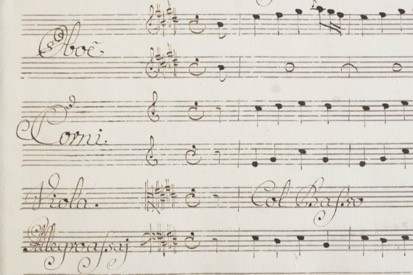
The assessment of scribes in handwritten musical sources not only supports editorial philology by aiding in the determination of manuscript provenance and dating but also enables conclusions about the professional practices of copyists, which are rarely documented in other sources. This study examines the collaborative work processes of music copyist workshops in mid-eighteenth-century Vienna, drawing on a comprehensive survey of opera score copies produced between 1760 and 1775. Shifting the traditional scholarly focus from copyists associated with individual composers to a specific repertoire within a defined geographical and institutional framework, it enables a systematic analysis of copyists active in the Viennese court’s theatrical sphere during this period. After the Habsburg court discontinued its official copyist position in 1755, commissions were assigned to independent copyist workshops, fostering a growing open market for sheet music. Within the timeframe under examination, three distinct copyist workshops can be identified, the most prominent being that of (Anna) Theresia Ziss (1700–77), widow of a long-serving court copyist. This case study introduces Ziss’s workshop as a framework for examining the division of labor and the responsibilities of a workshop’s head, as reflected in the manuscripts. Although copying tasks were distributed among multiple main and occasional copyists, the visual consistency of the workshop’s output was maintained through minimization of the number of scribes involved in each manuscript and transitions between copyists within volumes. As head of the workshop, Ziss ensured uniform quality through standardized title pages, final adjustments, and meticulous proofreading. In contrast, the workshops of Boniface Charles Champée, active in the 1760s, and of an unidentified scribe, WK71F, who became the court’s primary supplier in the early 1770s, exhibited slightly different organizational structures and professional practices, resulting in more heterogeneous manuscripts and reflecting the increasing complexity of the Viennese copyist landscape.